
Liquid Death - Fundamental Analysis Report 2026 (Updated)

Dear Readers, Welcome to Deep Research Global.
Let’s analyze the topic in detail.
Executive TL;DR
Liquid Death has scaled from a $3 million indie experiment in 2019 to roughly $333 million in 2024 retail revenue, with a $1.4 billion valuation set in its March 2024 Series F, positioning the brand as the rare canned-water challenger to actually crack mainstream conventional retail.
The company is shifting its center of gravity from canned water into multi-category beverages, with its Sparkling Energy line launching nationwide in January 2026 to attack the $23 billion energy drink category alongside Red Bull, Monster, Celsius and Alani Nu.
Recent operational signals are mixed: the brand has hired a new CFO from PepsiCo (October 2025), exited the United Kingdom in February 2025, and growth has decelerated from triple-digit to roughly 27% year-over-year.
Secondary market pricing data shows Liquid Death shares trading around $7.20 on Hiive and $8.75 on Forge as of mid-May 2026, suggesting private investors are repricing the unicorn ahead of a long-rumored but still unfiled IPO.
Recommended - Read Full Reports


Read All Reports
Table of Contents
Executive TL;DR
Introduction
Liquid Death Company Profile: Key Facts Snapshot
Investment Thesis: Why Investors Are Watching Liquid Death
Pillar 1: A Content Moat That Lowers Customer Acquisition Cost
Pillar 2: Aluminum Real Estate at a Plastic-Hostile Moment
Pillar 3: A Genuine Multi-Category Roadmap
Pillar 4: Optionality on Exit
Business Model Overview
How Liquid Death Actually Makes Money
Merchandise as a Margin Lever
Sourcing and Supply Chain
Direct-to-Consumer and Subscription
Liquid Death Revenue Analysis
Reported Annual Revenue Trajectory
Revenue Mix by Category
Geographic Concentration
Margins and Cash Flow
Gross Margin Outlook
Working Capital and Cash Flow Mechanics
Balance Sheet Health
Funding Stack
Debt and Liquidity
Dilution and Cap Table
Segment-by-Segment Teardown: Products and Categories
Still Mountain Water (Core SKU)
Sparkling Mountain Water
Soda-Flavored Sparkling
Iced Tea
Death Dust Electrolyte Powder
Sparkling Energy (Launching January 2026)
Merchandise
Distribution, Retail Footprint, and On-Premise
Conventional Retail Penetration
On-Premise and Venue
Direct-to-Consumer
West Coast Distributor Expansion
Strategic and Competitive Context
Bottled Water Incumbents
Premium Water and Sparkling
Functional Soda Challengers
Energy Drink Complex
Marketing Strategy and Brand Equity
In-House Creative Team
Brand Collaborations as PR Engine
Brand Risk Management
Sustainability Messaging
Latest Quarterly Trends and Guidance
Indirect Signals From Public Investors
Executive Commentary
Valuation Framework
Last Primary Round
Secondary Market Pricing
Revenue Multiple Benchmarks
Bull, Base, and Bear Case Scenarios
Bull Case: Energy Drink Takes Off, IPO Window Opens
Base Case: Energy Drinks Are Mid-Tier Success, M&A Optionality
Bear Case: Energy Drinks Stall, Growth Continues to Decelerate
Key Risks
Risk 1
Risk 2
Risk 3
Risk 4
Risk 5
Risk 6
Risk 7
Risk 8
Catalysts to Watch
Near-Term Catalysts (Next 6 to 12 Months)
Medium-Term Catalysts (12 to 24 Months)
Long-Term Catalysts (24 to 36 Months)
Customer Loyalty, Community, and Cultural Capital
Tattoo-Level Loyalty
User-Generated Content as Marketing Input
Cultural Partnerships
Governance, Leadership, and Talent
Founder and CEO
Chief Financial Officer
Marketing Leadership
Board and Investor Oversight
Industry Context: The U.S. Non-Alcoholic Beverage Market
Bottled Water Remains the Largest Beverage Category
Functional Soda and Better-for-You Beverages
Energy Drinks
Premium Water and Sparkling
My Final Thoughts
Latest Market Price Targets
Official Sources and Data
Disclaimer: This analysis is for informational & educational purposes only and should not be construed as investment advice. Investors should conduct their own due diligence and consult with their personal financial advisors before making investment decisions. Past performance does not guarantee future results.
Introduction
Liquid Death is the most polarizing canned beverage company in America: a brand that turned tallboys of still water into something teenagers tattoo on their arms, music venues stock as their exclusive water, and grocers shelve alongside hard seltzer.
Behind the death metal aesthetics sits an unusually disciplined business now testing whether a marketing engine built on irreverence can scale into a multi-category, multi-billion-dollar consumer platform.
This report unpacks the financials, product roadmap, distribution footprint, competitive landscape, and the realistic bull, base, and bear scenarios for Liquid Death heading into late 2026.
The brand is on the verge of its most consequential product launch ever, the Sparkling Energy line, at the exact moment the IPO question is back on the table.
Liquid Death Company Profile: Key Facts Snapshot
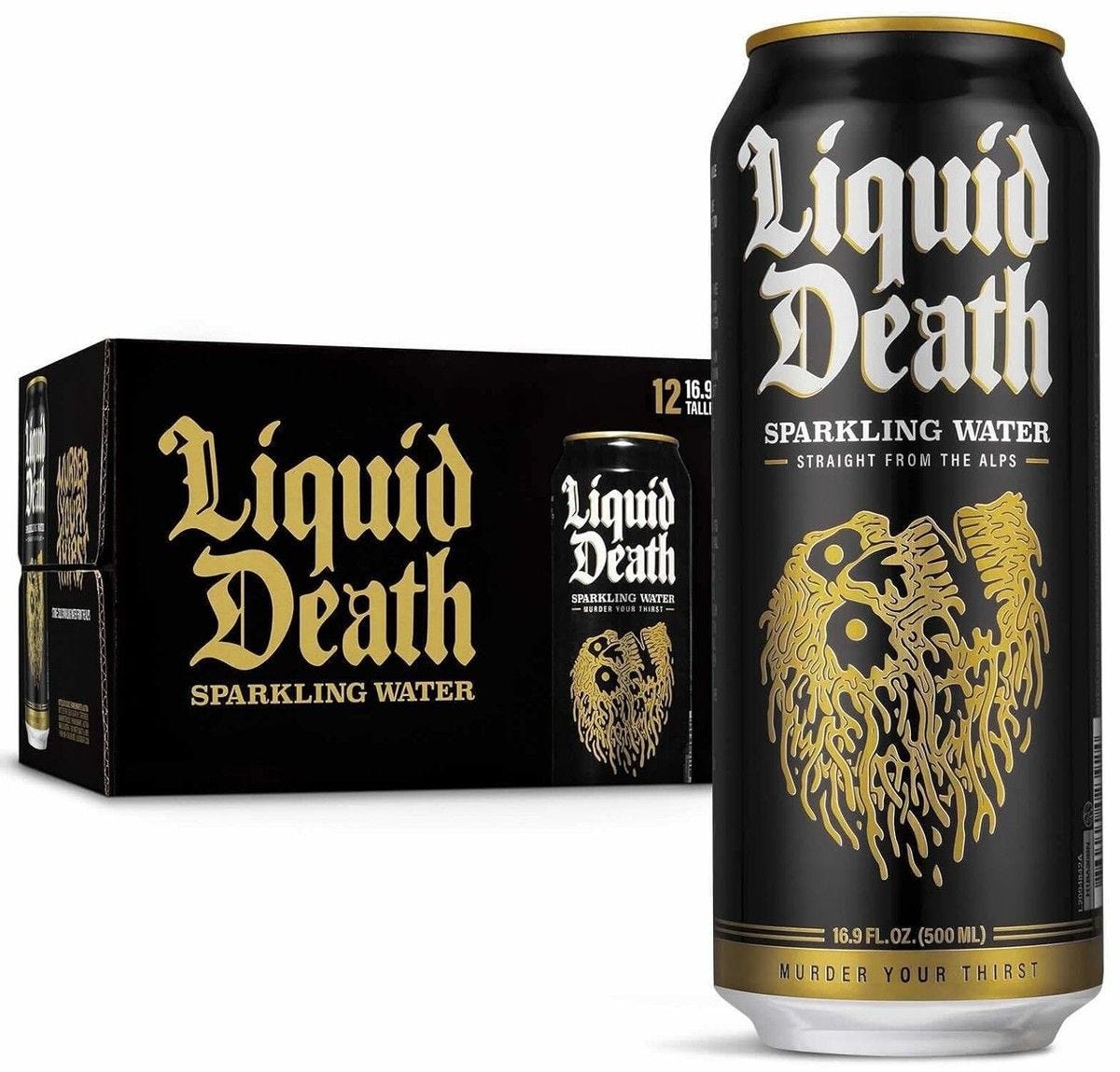
Liquid Death Mountain Water is a Los Angeles-based, privately held beverage company best known for selling still and sparkling water, iced tea, soda-flavored sparkling water, an electrolyte powder called Death Dust, and, as of 2026, a new energy drink lineup, all packaged in recyclable aluminum tallboys.
Legal entity         : Liquid Death Mountain Water (Delaware C-corp)
Founded              : 2017 (Los Angeles, California)
Founder & CEO        : Mike Cessario
CFO                  : Ricky Khetarpaul (appointed October 2025)
Latest disclosed
 valuation           : $1.4 billion (Series F, March 2024)
Total funding raised : approx. $267M to $396M depending on source
2024 revenue (est.)  : approx. $333 million
2024 YoY growth      : approx. 27 percent
Retail footprint     : 133,000-plus U.S. doors
Distribution status  : United States only (exited UK Feb 2025)
Product categories   : Still water, sparkling, soda-style sparkling,
                       iced tea, hydration powder, energy drinks
Notable investors    : Live Nation Entertainment, Science Inc.,
                       Gray's Creek Capital, SuRo Capital,
Swan Group, Josh Brolin and othersCEO Mike Cessario, a former advertising creative who launched the brand with $1,500, remains the dominant operating force. Cessario has continued to publicly position the company as a marketing-led, in-house-creative-driven entertainment business that happens to sell beverages.
The investor base is one of the more strategic in the beverage challenger universe.
Live Nation joined as an investor in 2021 and made Liquid Death the exclusive water sold at more than 120 Live Nation venues and amphitheaters across the country, giving the brand a physical real estate footprint that traditional beverage challengers cannot replicate.
Investment Thesis: Why Investors Are Watching Liquid Death
The Liquid Death investment thesis rests on four pillars that are unusual in beverage: a viral content moat, ownership of premium aluminum-can shelf real estate, a multi-category expansion playbook anchored in better-for-you positioning, and a long-tail option on either an IPO or a strategic acquisition by a beverage major.
Pillar 1: A Content Moat That Lowers Customer Acquisition Cost
Liquid Death’s most defensible asset is not its water source, its formula, or even its packaging.
It’s the company’s in-house creative team, which the CEO has described as functioning like a writers’ room rather than an advertising department. The brand has built a combined social following of more than 14 million by posting comedy content multiple times per week rather than running standard product ads.
The economic result is a customer acquisition cost that is unusually low for a venture-backed CPG brand. Where peers spend heavily on Meta and TikTok performance ads to generate retail demand, Liquid Death’s social engagement is itself the top of the funnel.
Vice President of Creative Andy Pearson has publicly argued that this in-house comedy machine produces faster, weirder, and more shareable content than any external agency could, and that the in-house model is becoming inevitable for ambitious challenger brands.
Pillar 2: Aluminum Real Estate at a Plastic-Hostile Moment
Liquid Death pioneered the tallboy can as a packaging format for still water in the United States, and the consumer rationale has only strengthened.
The Aluminum Association estimates aluminum cans carry one of the highest recycling rates of any beverage container in the United States, while concerns about microplastics and bisphenols leaching from plastic bottles have entered mainstream consumer awareness.
That tailwind matters because the United States bottled-water category is enormous and still growing.
Volume reached 16.4 billion gallons in 2024, making water the largest beverage category by volume in the country, with growth of about 2.9 percent year-over-year and outperforming every other packaged beverage.
Liquid Death is not trying to win the value-tier plastic-bottle case-pack war that Nestle, BlueTriton, Niagara, and store brands dominate.
It’s competing for premium cooler placement next to Red Bull, hard seltzer, and craft soda.
Pillar 3: A Genuine Multi-Category Roadmap
Most water brands die or stall at category one.
Liquid Death has now executed a credible expansion playbook spanning sparkling water, soda-flavored sparkling, iced tea, electrolyte powders, and as of January 2026, energy drinks.
Each adjacency comes with materially higher gross margins than still water and a deeper pocket of consumer occasions.
The energy drink launch is particularly important to the thesis.
Liquid Death is entering an energy category that company executives have described as a $23 billion U.S. opportunity, and where Celsius and Alani Nu have demonstrated that a single challenger brand can scale to over a billion dollars in retail sales in a few years.
Pillar 4: Optionality on Exit
Liquid Death has been openly discussed in financial press as an IPO candidate since the company hired Goldman Sachs to advise on a potential listing in 2023.
While no S-1 has been filed and the targeted 2024 listing window passed, the brand has continued to add institutional investors and raise additional capital.
The realistic outcome distribution likely includes a 2026 to 2027 IPO if public market appetite for premium CPG returns, a strategic acquisition by Coca-Cola, PepsiCo, Keurig Dr Pepper or Constellation Brands, or continued private growth funded by mature secondary markets.
Business Model Overview
Liquid Death operates a contract-manufactured, multi-channel beverage business built around a single, dominant brand wrapper.
The model is asset-light in production but heavy in brand investment, and it is increasingly diversified across product categories and channels.
How Liquid Death Actually Makes Money
The core mechanic is straightforward.
Liquid Death designs and brands beverages, contracts third-party canners and co-packers to fill its tallboys, and sells through three primary channels: traditional grocery and mass retail, convenience and on-premise, and direct-to-consumer through its own website.
Channel architecture

Tier 1: Traditional retail
        Walmart, Target, Kroger, Albertsons, Whole Foods,
        Sprouts, Publix, Wegmans, H-E-B
Tier 2: Convenience and on-premise
        7-Eleven, Speedway, gas stations, bars, restaurants,
        tattoo parlors, barber shops
Tier 3: Venue and entertainment
        Live Nation venues and amphitheaters, MSG properties,
        festivals, sports partnerships including LAFC
Tier 4: Direct-to-consumer
        Liquid Death website (water, beverages, merch),
        Amazon storefronts, third-party DTC fulfillment
The convenience and on-premise tier is structurally important because the c-store channel rewards premium-priced single-serve cans with higher per-unit gross profit than a six-pack sold through grocery.
The brand is now expanding deeper into the conventional channel with Albertsons, Kroger, Target and Walmart.
Merchandise as a Margin Lever
Liquid Death is one of very few beverage brands that runs merchandise as a meaningful gross profit contributor.
Branded apparel and accessories have historically carried gross margins materially above canned beverages, and the company has reported merch generating multi-million-dollar revenue contributions, including roughly $3 million in merch sales on $45 million of total 2021 revenue.
It’s estimated that merch contributes about 10 percent of total revenue and almost certainly a larger share of gross profit, given that hoodies, t-shirts, hats, and limited-edition collectibles can carry 60 to 70 percent gross margins.
The Tony Hawk blood-infused skateboard drop, which sold all 100 boards at $500 each in under 20 minutes, is the most-credible example of how Liquid Death uses scarcity drops to generate both meaningful merch revenue and viral PR.
Sourcing and Supply Chain
The company sources still mountain water in the United States.
After originally importing water from Austria, Liquid Death migrated its still water sourcing to a deep underground source in Bland County, Virginia and has consolidated production with United States-based co-packers.
This shift dramatically reduces freight cost per case, improves unit economics, and limits foreign-exchange and tariff exposure.
Direct-to-Consumer and Subscription
The Liquid Death website operates as a full DTC storefront for beverages, drink mixes, and merch.
While DTC is not the primary volume driver in a category dominated by grocery, the channel serves three strategic purposes: collecting first-party consumer data, hosting limited-edition product drops, and incubating new product launches before they hit retail.
Liquid Death Revenue Analysis
Liquid Death’s revenue trajectory is one of the steepest in modern beverage history, though growth has clearly