
Procter & Gamble (PG) - Fundamental Analysis Report 2026 (Updated)

Dear Readers, Welcome to Deep Research Global.
Let’s analyze the topic in detail.
Executive TL;DR
Procter & Gamble (PG) closed Q3 FY2026 on April 24, 2026 with net sales of $21.2 billion (up 7%), organic sales up 3%, core EPS of $1.59, and 10 of 10 product categories growing.
Management maintained full-year FY2026 core EPS guidance of $6.83 to $7.09 despite an estimated $1 billion in tariff-related cost pressure.
A 3% dividend hike in April 2026 extended the streak to 70 consecutive annual increases and the 136th uninterrupted year of dividend payments.
Shailesh Jejurikar became P&G’s new CEO on January 1, 2026, executing a two-year restructuring that includes roughly 7,000 non-manufacturing job cuts and selective brand exits.
Recommended - Read Full Reports


Read All Reports
Table of Contents
Executive TL;DR
Introduction
Procter & Gamble Company Profile: Key Facts Snapshot
Procter & Gamble Investment Thesis
Why the Daily-Use Portfolio Matters
Superiority as a Compounding Moat
Productivity as the Hidden Earnings Engine
P&G Business Model Overview
The Five Segments
Brand Architecture
Channel Mix and E-Commerce
Geographic Footprint
P&G Revenue Analysis
FY2025 Revenue Build
Quarterly Cadence Through FY2026
Pricing, Volume, and Mix Decomposition
Latest Quarterly Earnings Guidance, Margins, and Earnings Quality
FY2026 Guidance Framework
Margin Architecture
Earnings Quality Considerations
EPS Trajectory and Cash Flow Mechanics
Multi-Year EPS Walk
Operating Cash Flow Engine
Capital Allocation Discipline
Balance Sheet Health
Leverage and Liquidity
Pension and Other Long-Term Liabilities
P&G Segment-by-Segment Teardown
Fabric & Home Care
Baby, Feminine & Family Care
Beauty
Health Care
Grooming
Q3 FY2026 Segment Snapshot
Major P&G Competitors
List of Major Competitors
P&G vs. Unilever
P&G vs. Colgate-Palmolive
P&G vs. Kimberly-Clark
P&G vs. Reckitt Benckiser
P&G vs. L’Oréal
P&G Strategic Context
CEO Transition
Restructuring Program
Tariff Regime
P&G Valuation Framework
Earnings Multiple
Free Cash Flow Yield
Dividend Discount Considerations
Comparison to Peers
Bull, Base, and Bear Case Scenario Analysis
Bull Case
Base Case
Bear Case
Key Risks for P&G
Risk 1
Risk 2
Risk 3
Risk 4
Risk 5
Risk 6
Risk 7
Risk 8
Catalysts to Watch
Catalyst 1
Catalyst 2
Catalyst 3
Catalyst 4
Catalyst 5
Catalyst 6
My Final Thoughts
Latest Analyst Price Targets
Official Sources & Data
Disclaimer: This analysis is for informational & educational purposes only and should not be construed as investment advice. Investors should conduct their own due diligence and consult with their personal financial advisors before making investment decisions. Past performance does not guarantee future results.
Introduction
Procter & Gamble (PG) is no longer just a predictable, sleepy dividend stock that many investors assume.
The combination of a CEO transition, a billion-dollar tariff bill, a 7,000-job restructuring, and the nationwide rollout of Tide evo has turned fiscal 2026 into the most consequential operating year P&G has faced since the 2014 portfolio overhaul.
This in-depth analysis report cuts through the noise. It rebuilds the investment case segment by segment, isolates the tariff math, stress-tests cash returns, and benchmarks P&G against Unilever, Colgate-Palmolive, and Kimberly-Clark on the metrics that actually matter for long-term investors.
Procter & Gamble Company Profile: Key Facts Snapshot
P&G traces its history to 1837 in Cincinnati, Ohio, and today operates as the world’s most valuable publicly traded consumer-goods company by market capitalization. The portfolio spans 65+ brands across daily-use categories where, in management’s own framing, “performance drives brand choice.”
The company’s integrated growth strategy rests on five pillars: focused portfolio, superiority, productivity, constructive disruption, and an empowered organization.
Ticker (NYSE)         : PG
Headquarters          : Cincinnati, Ohio, USA
Founded               : 1837
Fiscal Year End       : June 30
FY2025 Net Sales      : $84.3 billion
Reportable Segments   : 5 (Beauty, Grooming, Health Care,
                        Fabric & Home Care, Baby/Feminine/Family)
Employees             : ~108,000
Brands w/ $1B+ Sales  : 23 (per FY25 disclosures)
Executive Chairman    : Jon R. Moeller
President & CEO       : Shailesh G. Jejurikar (since Jan 1, 2026)
CFO                   : Andre Schulten
The shareholder base is anchored by long-duration institutional capital, and the 70 consecutive annual dividend increases make P&G one of only a handful of true Dividend Kings in the S&P 500.
Procter & Gamble Investment Thesis
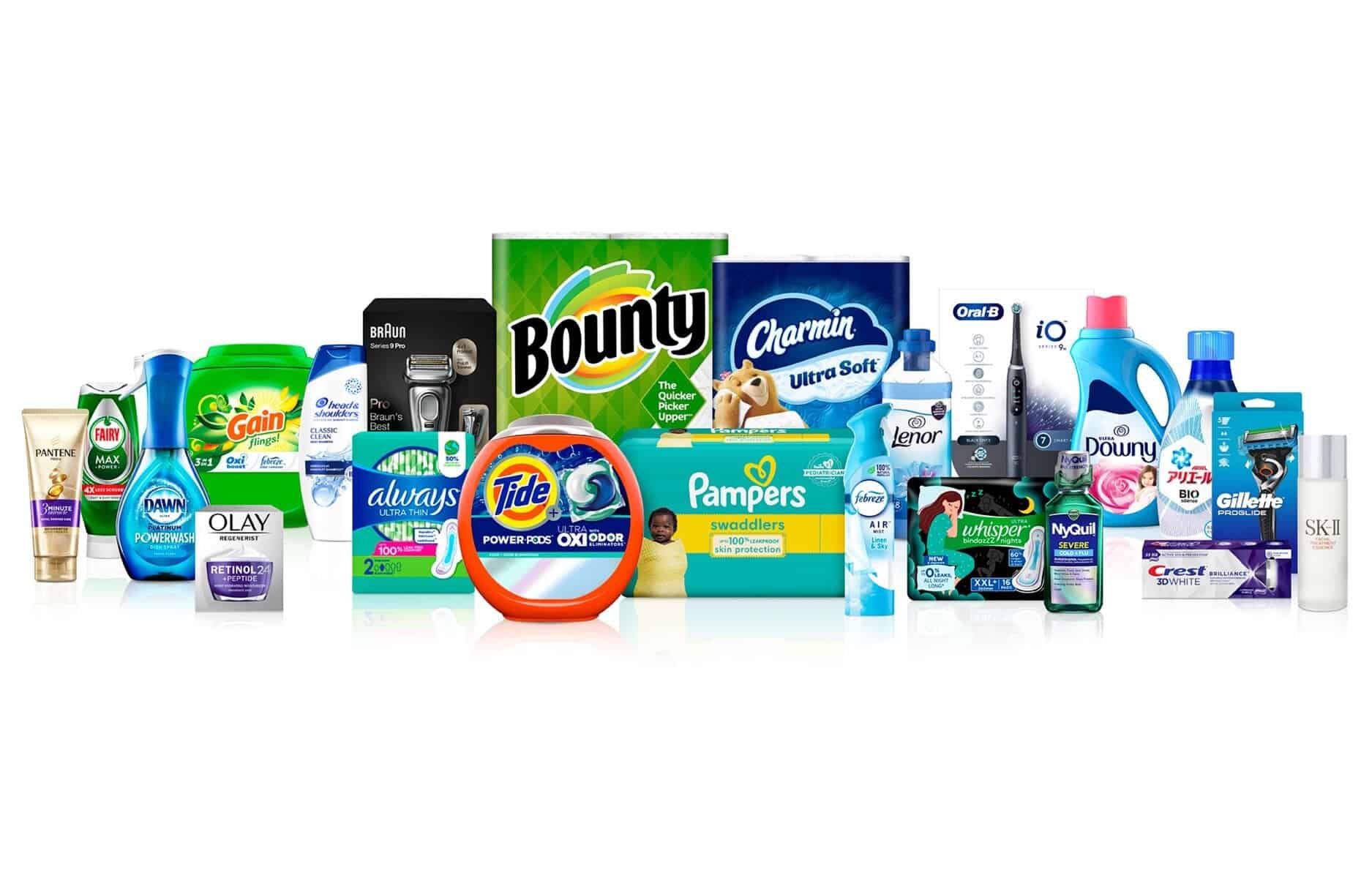
The simplest version of the bull case is this: P&G sells things consumers buy every week, in categories where superiority converts into pricing power, while productivity savings fund both innovation and shareholder returns.
Why the Daily-Use Portfolio Matters
Roughly 95% of P&G sales come from categories used at least weekly by consumers. That cadence drives basket loyalty and turns retailers into structurally dependent partners.
This portfolio design also creates pricing latitude that pure-play discretionary brands rarely enjoy. Even when consumers trade down within categories, they continue to buy.
WHY DAILY-USE MATTERS
1. High repeat rates compress acquisition cost per dollar
2. Habitual purchase reduces sensitivity to ad volume
3. Performance gap vs. private label is measurable, not subjective
4. Inelastic demand absorbs targeted price increasesSuperiority as a Compounding Moat
The “five vectors of superiority” framework spans product, package, brand communication, retail execution, and consumer value. Management has consistently said that when all five vectors are aligned, market share growth follows.
Two examples illustrate the playbook in motion.
Tide evo, the waterless laundry tile launched nationally in February 2026, addresses package innovation and sustainability simultaneously. SK-II, conversely, illustrates the consequences of a weakened vector mix in China.
Productivity as the Hidden Earnings Engine
P&G’s productivity program is structural, not mere promotional. Cost-of-goods savings, organizational simplification, and overhead absorption together fund innovation and offset commodity and currency shocks.
Management has framed FY2026 as a “transition year” in which productivity must absorb a roughly $1 billion tariff impact while still funding R&D and consumer-facing investment. That’s a high-bar test of the operating model.
P&G Business Model Overview
P&G operates as a vertically managed, globally distributed branded-goods manufacturer.
The company designs, formulates, sources, manufactures, packages, distributes, advertises, and merchandises consumer products through retail, e-commerce, and direct channels.
The Five Segments
Five reportable segments map onto distinct value chains, but share R&D platforms, packaging engineering, and global business services. This “shared services backbone” is part of the moat.
The shared-services design is also why P&G’s restructuring is structurally different from a peer cost-out program. Trimming overhead in Cincinnati cascades into all five segments at the same time.
Brand Architecture
Inside each segment, P&G runs a “house of brands” approach, where each brand owns a distinct positioning and price tier. Tide is mass-premium in laundry, Gain is mass, and Bounce is sub-premium.
This stratification lets P&G capture a share of multiple price tiers within a single retailer’s planogram, which is the kind of detail that compounds across thousands of stores and 180+ countries.
Channel Mix and E-Commerce
E-commerce was 19% of FY2025 net sales and grew 12% versus 2% organic for the company. The channel mix shift improves data granularity and shortens innovation feedback loops.
CHANNEL ECONOMICS (FY2025)
Total Net Sales      : $84.3B
E-commerce Share     : ~19% (≈$16B)
E-commerce Growth    : +12% YoY
Implication          : digital is roughly 5–6x the growth
                       rate of the consolidated business
Geographic Footprint
Focus markets, which include North America, most of Europe, and a few large developed markets, contributed the majority of FY2025 organic sales growth.
Enterprise markets, including Latin America, India, and parts of Asia, are the long-duration growth engine.
In Q3 FY2026, Focus markets grew 3% and Enterprise markets grew 5%. That spread is exactly the dispersion long-term investors should want to see.
P&G Revenue Analysis
This section drills into the latest revenue tape. The objective is to separate sustainable, mix-driven growth from accounting noise and one-offs.
FY2025 Revenue Build
Net sales for FY2025 were $84.3 billion, up 2% organically and roughly flat all-in. Nine of ten product categories grew organic sales, and three categories (Family Care, Personal Health Care, and one mid-single-digit cohort) led the year.
The quality of FY2025 growth was largely